What does an air receiver vessel actually do?
Storage is only part of the job. An air receiver does four things in a compressed air system, and each one affects how you size and specify it.
Pressure stabilisation. Compressed air demand rarely holds constant. Machinery starts and stops, tools cut in during peak shifts, and some processes draw sudden bursts. The receiver absorbs those swings so downstream pressure stays steady. The compressor no longer has to react to every change in demand.
Compressor protection. Every start under load puts mechanical stress on a compressor. A correctly sized receiver cuts the number of start/stop cycles. Fewer cold starts means the compressor lasts longer, draws less energy, and needs less maintenance over its life.
Moisture separation. As compressed air cools inside the vessel, water vapour condenses and drops out. The receiver works as a first-stage separator and takes some of the moisture load off your downstream filters and dryers. That makes the drain valve a working part of the vessel. An automatic drain is worth specifying, and there are two types. Timer-based drains open on a fixed schedule whether or not condensate is present, so they waste air when the interval runs too long and leave water behind when it runs too short. Float-based (zero-loss) drains open only when condensate is actually there, which makes them more accurate and cheaper to run.
Peak demand buffer. When instantaneous demand exceeds what the compressor can deliver, the receiver covers the gap. That matters most in plants with variable or cyclical air use, such as food production, automotive, and pharmaceutical lines, where a short surge should not drag the whole system's pressure down.
Wet receiver vs. dry receiver: which do you need?
Where the receiver sits in the system decides what it does. In many plants the answer is one of each.
A wet receiver sits between the compressor and the air dryer. It takes hot, moisture-laden air straight off the compressor and gives it time to cool and drop bulk condensate before the dryer sees it. That protects the dryer and lets it run more efficiently. The trade-off is corrosion: standing moisture inside the vessel attacks the walls if the drain is not managed.
A dry receiver sits after the dryer and filtration. It stores clean, treated air that is ready to use with no further conditioning. Under peak demand, this is the vessel that holds pressure steady without pushing more load through the dryer.
For most industrial installations, the best practice is both: a smaller wet receiver upstream and a larger dry receiver downstream. The wet vessel protects the dryer and knocks out bulk water; the dry vessel gives you clean air and real surge capacity.
Vertical or horizontal: which orientation do you need?
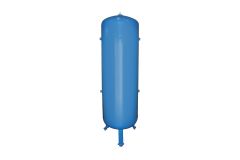
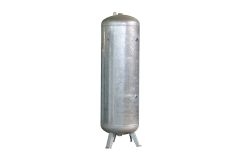
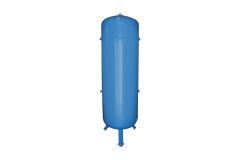
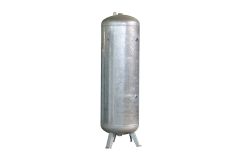
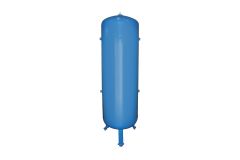
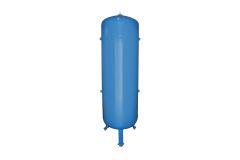
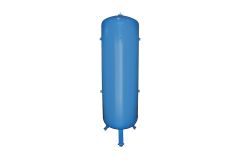
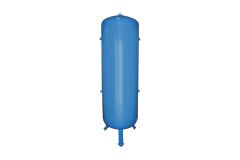
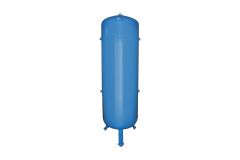
Vertical receivers are the usual choice in industrial plant rooms. They take up less floor space, which counts when space is tight. Gravity also pulls condensate down to the drain point at the base, so water is less likely to sit against the vessel wall. For most buyers, vertical is the default and the right call.
Horizontal receivers suit sites where headroom is limited. They also drop more easily into skid- or tank-mounted compressor packages. The trade-offs are a larger footprint and slightly weaker natural drainage. Currently horizontal receivers are not offered at Edmac.
Standard vertical models run from 100 to 1,000 litres, with working pressures up to 11 bar. Larger vessels are available to order for high-demand systems.
Material and finish. Most standard receivers are carbon steel with a protective coating inside and out, which suits general industrial air. Where the air is high-purity, or the environment is corrosive or gets washed down (common in food, pharmaceutical, and marine sites), stainless steel resists corrosion far better and lasts longer. The external finish and coating can be specified to match the installation.
Sizing an air receiver: getting it right
Undersizing is one of the most common and most expensive mistakes buyers make. A vessel that is too small forces the compressor to cycle constantly. That pushes up energy costs and accelerates wear.
The most commonly quoted rule of thumb is around 5 litres of receiver capacity per kW of compressor output. Treat that figure as a floor. It sits at the low end of published guidance; other sources put it at 6 to 10 litres per kW, or roughly 10 to 15 litres per CFM, and systems with variable or spiky demand should sit well above it. The factors that drive the real number are compressor output (litres per minute or m³/hour), system working pressure, how sharp and frequent the demand spikes are, dryer capacity, and duty cycle. High-cycle applications need more buffer, full stop.
When you are unsure, size up. The gap in price between one receiver size and the next is small. The lifetime cost of running an undersized system is not: you pay for it in energy, maintenance, and compressor wear.
Advanced sizing: need more precision than a rule of thumb?
The 5 litres/kW guideline is a safe minimum for general use. If your system has variable demand, tight pressure tolerances, or frequent peak loads, a proper calculation works from three inputs:
- Free Air Delivery (FAD) of your compressor
- Pressure band: the gap between cut-in and cut-out pressure your system can tolerate
- Peak demand duration: how long a surge must be supported before the compressor catches up
Those three figures set the actual usable capacity, which is different from nameplate volume. Rule-of-thumb sizing is a fine starting point, but it cannot model your real demand profile.
Talk to our specialists and we will size the vessel against your system's demand curve rather than its compressor rating alone. Contact our sales specialists for a demand-profile calculation.
Compliance and safety: what to look for
Air receiver vessels are pressure vessels, so they are regulated. Running a non-compliant vessel carries real consequences for both safety and insurance cover.
Every compliant vessel should have: a pressure relief valve set at or below the maximum allowable working pressure (MAWP); a pressure gauge rated to at least 1.5× the operating pressure; a drain valve at the lowest point, ideally an automatic float-based (zero-loss) unit; and a nameplate showing pressure rating, capacity, serial number, and certification details.
Never buy a non-certified vessel for industrial use. The short-term saving is not worth the liability. If you are not sure which vessel meets your requirements, contact our sales specialists for guidance.
Q&A: Your Top Questions About Air Receiver Vessels Answered
How often should an air receiver vessel be inspected?
Under UK PSSR rules, the interval is set by your written scheme of examination, typically every 12 to 26 months depending on the vessel and how it is run. Vessels exposed to high moisture or hard duty cycles need checking more often. Keep the inspection plate near the base accessible, and set the schedule with a competent person or your insurance inspector.
What causes internal corrosion, and how do I prevent it?
Condensate. Water that pools inside the vessel, especially in a wet receiver, attacks carbon steel from the inside. The fix is consistent drainage. A float-based (zero-loss) drain opens whenever condensate is present, so nothing depends on an operator remembering to do it. Regular internal inspection during your scheduled examinations catches corrosion before it turns structural. For high corrosion risk, our stainless steel vessels resist it far better and last longer.
Can I use an Edmac air receiver with any compressor brand?
Yes. Edmac air receiver vessels are standalone pressure vessels, compatible with compressed air systems from every major compressor manufacturer. What matters is sizing the vessel to your compressor's output and working pressure; brand does not come into it. Whether you run Ingersoll Rand, Boge, Kaeser, or anything else, Edmac has you covered.
What's the difference between working pressure and maximum allowable working pressure (MAWP)?
Working pressure is what your system runs at day to day. MAWP is the maximum the vessel is certified to hold safely. Always pick a vessel rated above your working pressure, usually by 10 to 15%, so the safety relief valve can act before the vessel nears its limit. Do not select one rated at exactly your system pressure; that headroom is what keeps the installation safe and compliant.